
Codex Borgia, The

Codex Borgia, The

Diaz, Gisele / Rodgers, Alan

$476.00 MXN

Sinopsis

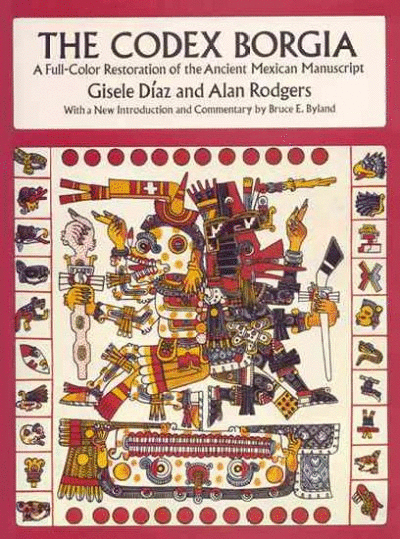
Considered by many scholars the finest extant Mexican codex and one of the most important original sources for the study of pre-Columbian religion, the Codex Borgia is a work of profound beauty, filled with strange and evocative images related to calendrical, cosmological, ritual, and divinatory matters. Generally similar to such Mixtec manuscripts as the Codex Nuttall, the Codex Borgia is thought to have its origin (ca. A.D. 1400) in the southern central highlands of Mexico, perhaps in Puebla or Oaxaca. It is most probably a religious document that once belonged to a temple or sacred shrine.

One use of the Codex many have been to divine the future, for it includes ritual 260 day calendars, material on aspects of the planet Venus, and a sort of numerological prognostic of the lives of wedded couples. Another section concerns various regions of the world and the supernatural characters and attributes of those regions. Also described are the characteristics of a number of deities, while still other passages relate to installation ceremonies of rulers in pre-Columbian kingdoms.

Until the publication of this Dover edition, the Codex Borgia has been largely inaccessible to the general public. The priceless original is in the Vatican Library and previous photographic facsimiles are very rare or very expensive or both. Moreover, the original Codex has been damaged over the centuries, resulting in the obscuration and loss of many images. In order to recapture the beauty and grandeur of the original, Gisele Diaz and Alan Rodgers have painstakingly restored the Codex by hand— a seven-year project — employing the most scrupulous research and restoration techniques. The result is 76 large full-color plates of vibrant, striking depictions of gods, kings, warriors, mythical creatures, and mysterious abstract designs — a vivid panorama that offers profound insights into pre-Columbian Mexican myth and ritual. Now students, anthropologists, lovers of fine art and rare books — anyone interested in the art and culture of ancient Mexico — can study the Codex Borgia in this inexpensive, accurate, well-made edition. An informative introduction by noted anthropologist Bruce E. Byland places the Codex in its historical context and helps elucidate its meaning and significance.

Editorial:
Dover Publications
Año de edición:
1993
Materia
Antropología
ISBN:
978-0-486-27569-7
Páginas:
112
Encuadernación:
Pasta blanda
Idioma:
Inglés

Disponibilidad en Centros

  • Condesa
  • Polanco
  • Santa Fe
  • Perisur
  • Zona Rosa
  • Roma
  • San Ángel
  • Del Valle

Advertencia: Las existencias de nuestro sistema no son precisas al 100%, por lo que antes de dirigirte a una de nuestras sucursales, te recomendamos que llames por teléfono para confirmar su disponibilidad.
Comentarios


Añadir comentario

Libros relacionados

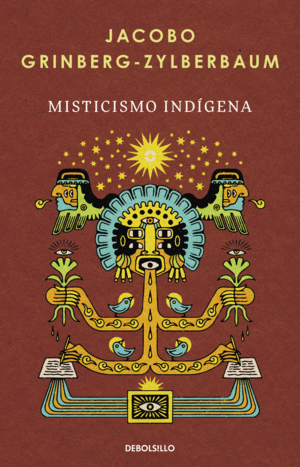
  • Misticismo indígena
    Grinberg-Zylberbaum, Jacobo
    «EL CORRELATIVO FÍSICO DE LA CONCIENCIA VIVA DE MÉXICO ES UN HIPERCAMPO RESULTANTE DE TODAS LAS INTERACCIONES ENTRE NUESTROS CEREBROS. SON LOS MÍSTICOS AUTÓCTONOS QUIENES SON CAPACES DE DETECTARLO, CONOCERLO Y DETERMINAR SU FLUJO Y LA DIRECCIÓN DE SUS EFECTOS.»-J. G. Z.En Misticismo indígena Jacobo Grinberg continúa con el estudio de la vida y el pensamiento de diversos chamane...

    $179.00 MXN

    En stock
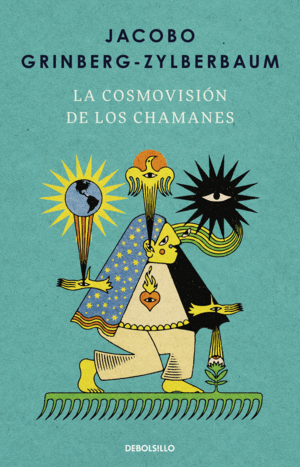
  • Cosmovisión de los chamanes, La
    Grinberg-Zylberbaum, Jacobo
    «EXISTEN TRES NIVELES DIFERENTES ENTRE LOS PSICÓLOGOS AUTÓCTONOS MEXICANOS. EL MÁS EVOLUCIONADO ENTRE ELLOS ES EL DEL MAESTRO, EL QUE SABE, EL QUE GUÍA Y ENTRENA A OTROS. A ESTE NIVEL, PODRÍAMOS ADJUDICARLE EL TÉRMINO DE CHAMÁN.»-J. G. Z.La cosmovisión de los chamanes es una puerta de entrada al pensamiento y la práctica espiritual de los chamanes indígenas de nuestro país, a t...

    $199.00 MXN

    En stock
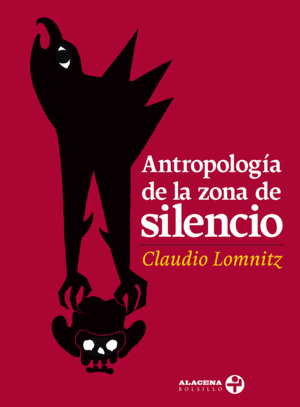
  • Antropología de la zona del silencio
    Lomnitz, Claudio
    La expresión “zona de silencio” se refiere a regiones donde la violencia ha instaurado tal miedo entre la población que el periodismo no puede ejercerse libremente y las vías comunicativas informales, como el rumor, se vuelven fundamentales para sus habitantes. Comprender cómo se conforman estas geografías en México es vital para desentrañar la lógica de la violencia en nuestro...

    $269.00 MXN

    En stock
  • Comemos lo que somos
    Mulet, J.M.
    Del tuétano de mamut al fast food, el nuevo libro de Mulet«Somos lo que comemos», decimos coloquialmente para expresar que la base de nuestra sociedad es la alimentación. No obstante, la comida, más allá de ser imprescindible para la supervivencia, es el reflejo de nuestra historia y cultura milenarias, por lo que cada plato esconde una tradición y cada sabor representa un mome...

    $449.00 MXN

    En stock
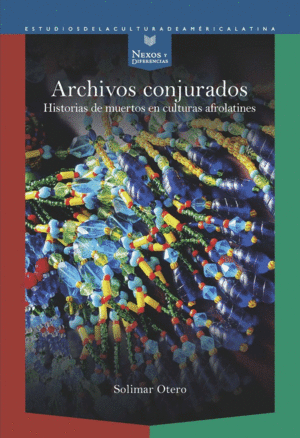
  • Archivos conjurados
    Otero, Solimar
    Ganador del Premio Albert J. Raboteau 2021 al Mejor Libro de Religiones Africanas, esta obra explora cómo espíritus afrolatines guían un trabajo activista colaborativo espiritual-académico a través de rituales y de la creación de cultura material, mostrando que las divinidades y los ancestros fungen de agentes activos en la conformación de las experiencias del género, la sexual...

    $809.00 MXN

    En stock
  • Cerebro y los chamanes, El
    Grinberg-Zylberbaum, Jacobo
    «LOS CHAMANES DE MÉXICO HAN LOGRADO DESPERTAR LA ACTIVACIÓN DE FUNCIONES COMPLEJAS EN SU CEREBRO DEBIDO ASU INTEGRIDAD Y CONGRUENCIA CON UNA SERIE DE ENSEÑANZAS DE LAS QUE SON HEREDEROS.» J. G. Z.El cerebro y los chamanes es parte de la colección Chamanes de México, una obra monumental de investigación tanto científica como antropológica en la que Jacobo Grinberg trabajó durant...

    $199.00 MXN

    En stock