
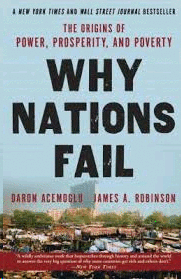
Why Nations Fail

Why Nations Fail

The Origins of Power, Prosperity, and Poverty

Acemoglu, Daron

$443.00 MXN

Sinopsis

Brilliant and engagingly written, Why Nations Fail answers the question that has stumped the experts for centuries: Why are some nations rich and others poor, divided by wealth and poverty, health and sickness, food and famine?

Is it culture, the weather, geography? Perhaps ignorance of what the right policies are?

Simply, no. None of these factors is either definitive or destiny. Otherwise, how to explain why Botswana has become one of the fastest growing countries in the world, while other African nations, such as Zimbabwe, the Congo, and Sierra Leone, are mired in poverty and violence?

Daron Acemoglu and James Robinson conclusively show that it is man-made political and economic institutions that underlie economic success (or lack of it). Korea, to take just one of their fascinating examples, is a remarkably homogeneous nation, yet the people of North Korea are among the poorest on earth while their brothers and sisters in South Korea are among the richest. The south forged a society that created incentives, rewarded innovation, and allowed everyone to participate in economic opportunities.

The economic success thus spurred was sustained because the government became accountable and responsive to citizens and the great mass of people. Sadly, the people of the north have endured decades of famine, political repression, and very different economic institutions—with no end in sight. The differences between the Koreas is due to the politics that created these completely different institutional trajectories.

Based on fifteen years of original research Acemoglu and Robinson marshall extraordinary historical evidence from the Roman Empire, the Mayan city-states, medieval Venice, the Soviet Union, Latin America, England, Europe, the United States, and Africa to build a new theory of political economy with great relevance for the big questions of today, including:

- China has built an authoritarian growth machine. Will it continue to grow at such high speed and overwhelm the West?

- Are America’s best days behind it? Are we moving from a virtuous circle in which efforts by elites to aggrandize power are resisted to a vicious one that enriches and empowers a small minority?

- What is the most effective way to help move billions of people from the rut of poverty to prosperity? More philanthropy from the wealthy nations of the West? Or learning the hard-won lessons of Acemoglu and Robinson’s breakthrough ideas on the interplay between inclusive political and economic institutions?

Editorial:
Crown publishers
Año de edición:
2013
Materia
Economía
ISBN:
978-0-307-71922-5
Páginas:
529
Encuadernación:
Pasta blanda
Idioma:
Inglés

Disponibilidad en Centros

  • Condesa
  • Polanco
  • Santa Fe
  • Perisur
  • Zona Rosa
  • Roma
  • San Ángel

Advertencia: Las existencias de nuestro sistema no son precisas al 100%, por lo que antes de dirigirte a una de nuestras sucursales, te recomendamos que llames por teléfono para confirmar su disponibilidad.

Comentarios


Añadir comentario

Libros relacionados

  • Personas de la economía popular en la...
    Alba Vega, Carlos
    El objetivo de este libro es averiguar quiénes son las personas que trabajan en la economía popular de la Ciudad de México, cómo han cambiado a través del tiempo y cuál es su situación laboral. Se busca indagar sobre sus estrategias económicas, políticas y sociales de sobrevivencia en contextos de desigualdad y de pobreza. Además, se vincula esta caracterización de las personas...

    $215.00 MXN

    En stock
  • Concepto de Estado en Marx, El
    García Linera, Álvaro
    Un texto intelectualmente provocador y políticamente útil para los tiempos convulsos que atravesamos.El propósito de este libro es abordar las propuestas teóricas que, desde el marxismo y el pensamiento crítico, se han hecho sobre el Estado y la posición de Marx sobre el mismo, algunas de las cuales se han sumado a las críticas liberales respecto a que no tenía una teoría del E...

    $299.00 MXN

    En stock
  • Como duplicar el ingreso de todos los...
    Alva, Salvador
    Este libro muestra las inmensas oportunidades de México para posicionarse como una economía de alto crecimiento. Duplicar el ingreso de todos los mexicanos exige una visión compartida y enfocada en impulsar el emprendimiento, desarrollar el talento y evolucionar hacia ciudades atractivas y sostenibles. El autor revela cómo realizar este cambio y nos invita a imaginarnos un Méxi...

    $351.00 MXN

    En stock
  • Camino de libertad
    Stiglitz, Joseph
    El nuevo libro de Joseph Stiglitz, Premio Nobel de EconomíaLa libertad es la idea que subyace a las sociedades occidentales, pero de un tiempo a esta parte su significado se ha desplazado: la libertad es la libertad de las empresas para contaminar, la de las grandes tecnológicas para escapar de cualquier control y la de los políticos para mentir y fomentar la crispación. ¿Cómo ...

    $399.00 MXN

    En stock
  • Poder inhumano
    Dyer-Witheford, Nick
    La Inteligencia Artificial (IA) ha tenido avances considerables en los últimos años. Si bien las máquinas siempre fueron centrales para el análisis marxista del capitalismo, la IA es un nuevo tipo de máquina que Marx no podría haber anticipado. La IA contemporánea de aprendizaje automático permite que las máquinas se acerquen cada vez más a las capacidades humanas de percepción...

    $610.00 MXN

    En stock
  • Ciudad Neoliberal, La
    Pinson, Gilles
    Recurrentemente presentada como escenario y explicación de problemas sociales como la exclusión, la pobreza y la desigualdad, en las últimas décadas la ciudad neoliberal ha dado lugar a una fecunda reflexión académica en los estudios urbanos y en la geografía crítica. Esa profusa literatura amplió la discusión sobre el tema, dando lugar a una utilización, a veces irreflexiva y ...

    $215.00 MXN

    En stock