
The Louvre: The very name conjures up scenes of art and elegance, and of long halls filled with beauty and people strolling through them whispering quietly among themselves about the glories they are witnessing. Even those who have never been to the Louvre know some of its most prized possessions, from ancient statues to Leonardo Da Vinci's "Mona Lisa". As the world's largest museum, the Louvre is unquestionably the cultural highpoint of Paris, a city that has long been considered the cultural center of Europe.
However, life is rarely as simple as one imagines, and the life of the Louvre is no different. While just about everyone is familiar with its history as an art museum, the Louvre's history goes back over 800 years, and it used to have far different purposes, both as a medieval fortress and a palatial residence for French kings. The Louvre bore witness to mass murder during the French Revolution, and there have been countless accusations of theft and other questionable actions since its opening.
Furthermore, the museum is also a classic example of beating one's swords into ploughshares, for it has been largely stocked through the conquests of war. Its first collection was put on display by a king who wanted to share his personal art collection with his subjects. Following the French Revolution, the Louvre became a place of ascetic refuge, where those burdened by daily life could go, often at no cost, and visit some of the most beautiful pieces of art in the world. While the power hungry Napoleon made war across the continent, he was also always on the lookout for beautiful and interesting items to send home to his people. Later, when rioters attempted to burn the building down, the museum portion of the palace survived, almost by miracle, and when the Nazis occupied Paris, they found that most of the items of value had been safely sent away. Ironically, when World War II was over, the museum became a safehouse for items stolen by the Germans from around the world, and a conduit to get the pieces back to their rightful owners. Even now, in the 21st century, the museum is serving as a bridge to peace and understanding; its latest gallery was designed to showcase Islamic art in the hope of bringing together people from different cultures. This is, to say the least, quite a change of pace for a fortress originally intended to fight off invaders.
Catherine the Great came to power in the midst of the Enlightenment, which was flourishing in France and Britain, and she would rule as an Enlightened ruler. A known correspondent of Voltaire's, Catherine sought to modernize Russia and turn it into a force in its own right, creating a rich and cultured court at the same time. Over the course of nearly 35 years in power, Catherine ushered in the Russian Enlightenment and presided over a period of time known as the Golden Age of the Russian Empire.
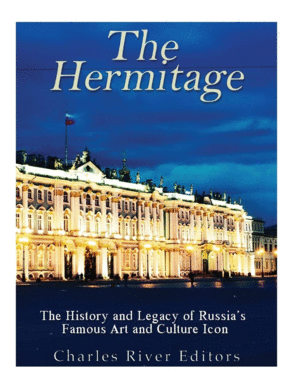
Moreover, Catherine had an unmatched passion for the arts, and she began a private art collection that would eventually evolve into galleries upon galleries of historical treasures shipped in from all over the world. This fabled museum was none other than the Hermitage, located in the heart of Saint Petersburg, a city founded by the imperial empire's very own Peter the Great.
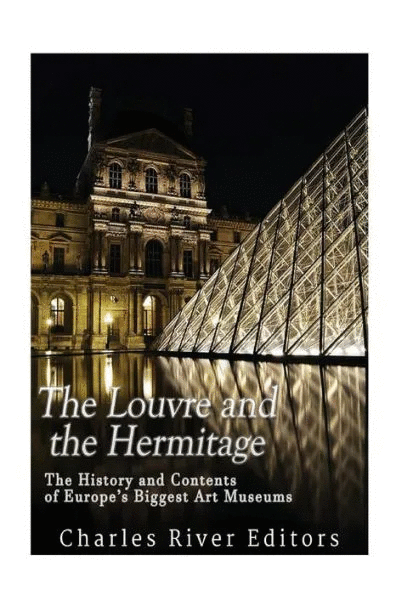
The Louvre and the Hermitage: The History and Contents of Europe's Biggest Art Museums chronicles the remarkable history of the museums and profiles some of their most important pieces. Along with pictures depicting important people, places, and events, you will learn about the Louvre and the Hermitage like never before.
*Includes pictures
*Includes contemporary accounts
*Profiles the various art in each museum
*Includes online resources and a bibliography for further reading
Advertencia: Las existencias de nuestro sistema no son precisas al 100%, por lo que antes de dirigirte a una de nuestras sucursales, te recomendamos que llames por teléfono para confirmar su disponibilidad.