
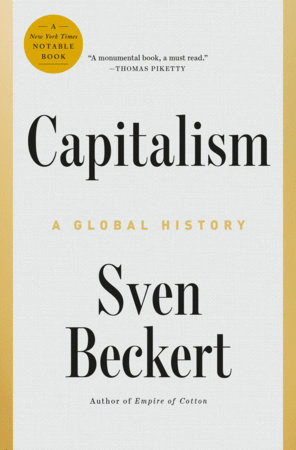
A New York Times Notable Book • A Financial Times Best Book of the Year
“A learned, formidable and vivid story… Readers around the world will study and ponder this monumental work of history, agreeing and arguing with it, all the while affirming its generational importance, for decades to come.” — Marcus Rediker, The New York Times
“Epic… Read this book and you will learn innumerable things you did not previously know culled from places you have never been… [Readers], including me, will be genuinely grateful for exposure to this breadth of scholarship and be glad to have a valuable tool of reference on their shelves.” –John Kay, Financial Times
A landmark event years in the making, a brilliant global narrative that unravels the defining story of the past thousand years of human history
No other phenomenon has shaped human history as decisively as capitalism. It structures how we live and work, how we think about ourselves and others, how we organize our politics. Sven Beckert, author of the Bancroft Prize–winning Empire of Cotton, places the story of capitalism within the largest conceivable geographical and historical framework, tracing its history during the past millennium and across the world. An epic achievement, his book takes us into merchant businesses in Aden and car factories in Turin, onto the terrifyingly violent sugar plantations in Barbados, and within the world of women workers in textile factories in today’s Cambodia.
Capitalism, argues Beckert, was born global. Emerging from trading communities across Asia, Africa, and Europe, capitalism’s radical recasting of economic life rooted itself only gradually. But then it burst onto the world scene, as a powerful alliance between European states and merchants propelled them, and their economic logic, across the oceans. This, Beckert shows, was modern capitalism’s big bang, and one of its epicenters was the slave labor camps of the Caribbean. This system, with its hierarchies that haunt us still, provided the liftoff for the radical transformations of the Industrial Revolution. Fueled by vast productivity increases along with coal and oil, capitalism pulled down old ways of life to crown itself the defining force of the modern world. This epic drama, shaped by state-backed institutions and imperial expansion, corresponded at no point to an idealized dream of free markets.
Drawing on archives on six continents, Capitalism locates important modes of agency, resistance, innovation, and ruthless coercion everywhere in the world, opening the aperture from heads of state to rural cultivators. Beckert shows that despite the dependence on expansion, there always have been, and are still, areas of human life that the capitalist revolution has yet to reach.
By chronicling capitalism’s global history, Beckert exposes the reality of the system that now seems simply “natural.” It is said that people can more easily imagine the end of the world than the end of capitalism. If there is one ultimate lesson in this extraordinary book, it’s how to leave that behind. Though cloaked in a false timelessness and universality, capitalism is, in reality, a recent human invention. Sven Beckert doesn’t merely tote up capitalism’s debits and credits. He shows us how to look through and beyond it to imagine a different and larger world.
Advertencia: Las existencias de nuestro sistema no son precisas al 100%, por lo que antes de dirigirte a una de nuestras sucursales, te recomendamos que llames por teléfono para confirmar su disponibilidad.