
The twenty-three papers and five editorials collected in this volume speak to subjects of bio-design, speculative biology, green walls and pavers, design by decay, soilless soil, sentient materials, photogrammetrees, robotics, nanotechnology, thermal architecture and alliesthesia, digital weaving, chemical droplets, and even Frankenstein. More broadly, ideas and questions that animate the two dozen articles collected in B/M/T/S are grounded in the production and representation of emergent ecologies, non-human agency, machine learning, and responsive computation.
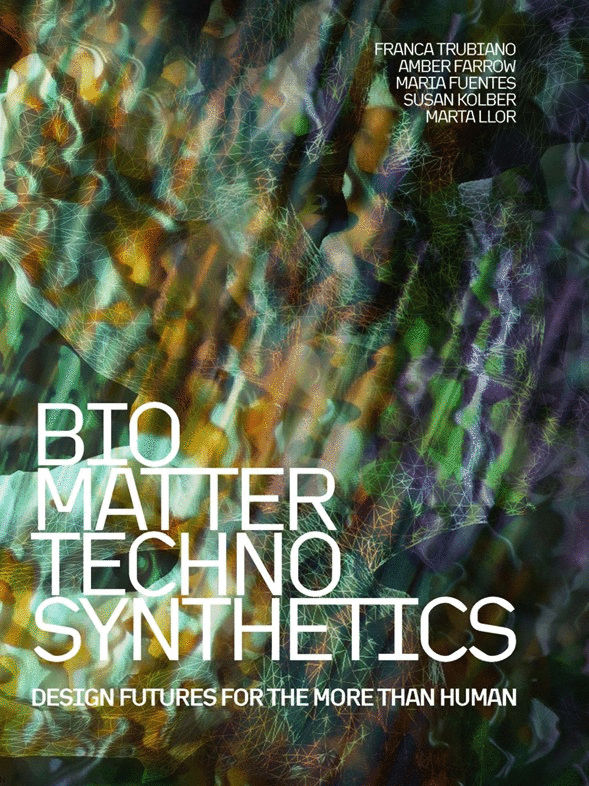
Bio/Matter/Techno/Synthetics: Design Futures for the More Than Human (B/M/T/S) captures and disseminates inspiring voices in contemporary design practicing in the fields of architecture, landscape architecture, art, ecology, environmental design, material studies, emerging technologies, media, artificial intelligence, and critical theory. B/M/T/S articulates future ready visions for a field that is increasingly called upon to participate in ever more complex aesthetic, ethical, environmental and socio-political contexts. B/M/T/S does this by redefining the very origins, principles, and values of design. Despite the propensity of contemporary discourse to favor the search for a hegemonic theory, this collaborative project convenes the work of twenty- eight women, all of whom interrogate the origins, methods, and tactics of their respective disciplines.
Collectively, B/M/T/S challenges the common place nature of ideas founded in parametricism, object- oriented ontology, parafictional realism, post-digital representations, and corporate functionalism. In exchange, it seeks the confluence of critical, aesthetic, and ethical thought in future speculations on the biological, the material, the technological, and their synthesis. It does this at scales that operate across multiple disciplines and territories. The twenty-three papers and five editorials collected in this volume speak to subjects of bio-design, speculative biology, green walls and pavers, design by decay, soilless soil, sentient materials, photogrammetrees, robotics, nanotechnology, thermal architecture and alliesthesia, digital weaving, chemical droplets, and even Frankenstein. More broadly, ideas and questions that animate the two dozen articles collected in B/M/T/S are grounded in the production and representation of emergent ecologies, non-human agency, machine learning, and responsive computation.
The book’s interdisciplinary framework guides the much-needed synthesis of design with biology, material studies, and emerging digital technologies; design being the interdisciplinary lens through which their interdependence and independence is channeled and challenged. A range of speculative theories, physical projects, material and digital technologies, as well as social critiques are offered that explore our relationship to design as a form of synthesis. Individually and collaboratively, the essays in B/M/T/S question well-established disciplinary methods in favor of new ways for actualizing previously marginalized ideas, values, and practices. Committed to an ethics of synthesis, B/M/T/S explores the limits and potential of designing with multiplicity, metamorphosis, and hybridization. The book’s authors demonstrate a variety of reconciliatory practices for cross-pollinating ideas, materials, and technologies in their drive to design a future world that is always more than human, materially constituted, artificially charged, and synthetically embedded.
Contributions by: Sonja Du¨mpelmann, Aroussiak Gabrielian, Gundula Proksch, Pinar Yoldas, Lucinda Sanders, Ayasha Guerin, Laia Mogas Soldevilla, Andrea Ling, Mae-Ling Lokko, Rebecca Popowsky, Julia Lohmann, Martina Decker, Behnaz Farahi, Stefana Parascho, Dorit Aviv, Viola Ago, Jacqueline Wu, Sophie Hochha¨usl, Clarissa Tossin, Jenny Sabin, Rachel Armstrong, Patricia Olynyk, Kathy Velikov
Advertencia: Las existencias de nuestro sistema no son precisas al 100%, por lo que antes de dirigirte a una de nuestras sucursales, te recomendamos que llames por teléfono para confirmar su disponibilidad.